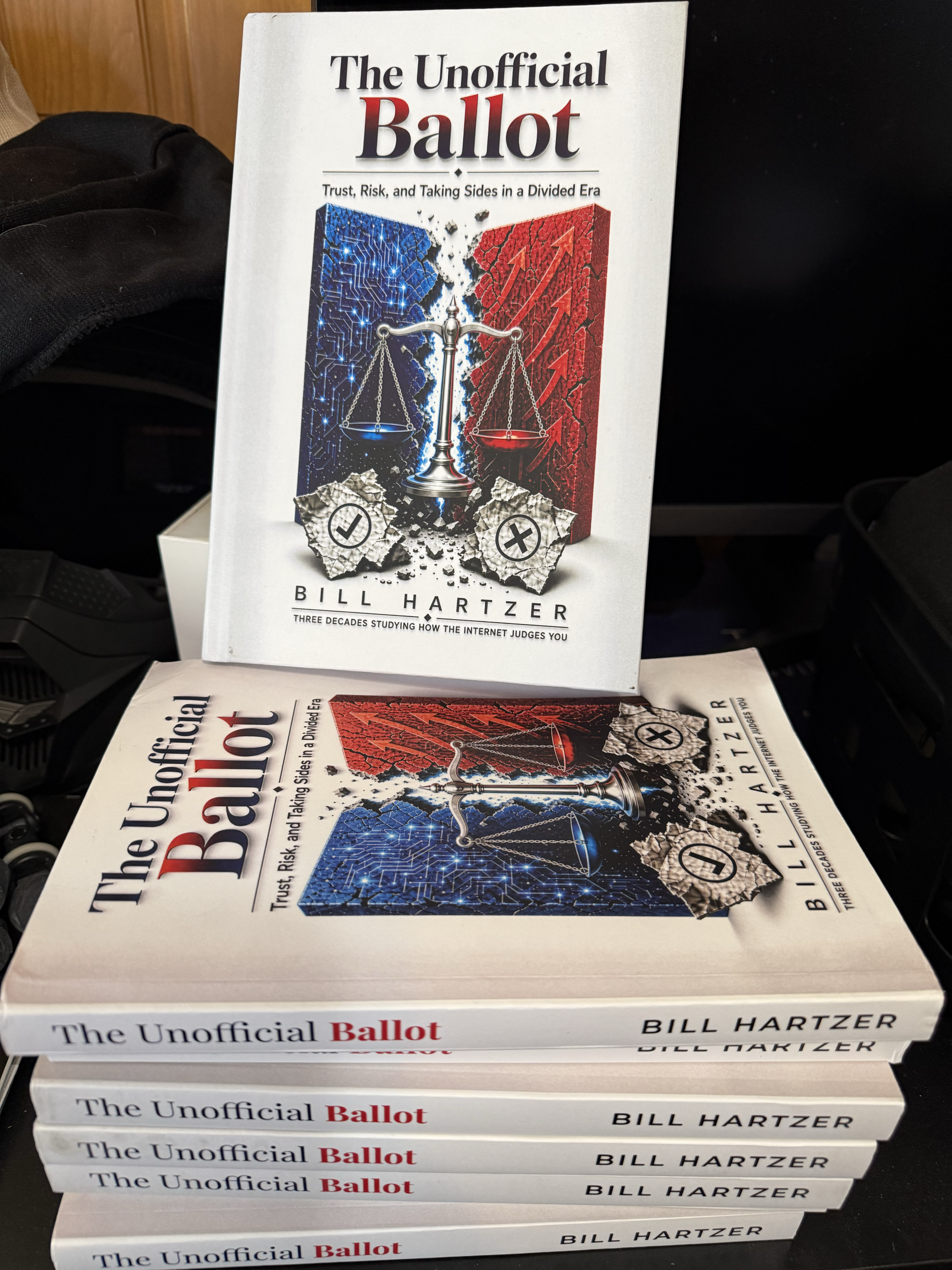
After seeing the election results and some of the conversations taking place on social media today, I was reminded of something that prompted me to write my book, The Unofficial Ballot: Trust, Risk, and Taking Sides in a Divided Era
Deciding whether to speak up about a controversial issue isn’t always easy. And it’s a decision that can have consequences well beyond the initial conversation.
For individuals, it can affect personal relationships, professional opportunities, and reputations. For businesses and organizations, the stakes can be even higher. A public statement can strengthen relationships with some customers while alienating others. Remaining silent can also send a message, whether that was the intention or not.
So, how do you decide?
Every Public Statement Comes With a Decision
Social media makes it incredibly easy to react to current events. You see something happening, read a few comments, and feel compelled to respond.
Sometimes that response is exactly what you intended. Other times, it happens in the heat of the moment.
The problem is that public statements can live online long after the original conversation has ended. A post written in frustration can be shared, quoted, archived, and viewed by people who have no understanding of the original circumstances.
For business owners, executives, organizational leaders, and professionals, there’s another consideration: your personal opinions and professional reputation aren’t always viewed separately.
That doesn’t mean you should avoid controversial topics. It means you should think carefully about what you say, why you’re saying it, and what you hope to accomplish.
Staying Silent Is Also a Decision
One of the ideas I explore in The Unofficial Ballot is that choosing not to speak about an issue is still a choice.
People sometimes assume that staying silent means staying neutral. That’s not necessarily how others interpret it.
Customers, employees, business partners, and the public may have expectations about what an organization should say or do. When an issue becomes particularly important to a particular audience, silence can be interpreted in different ways.
But speaking out has risks, too.
There is no universal rule that says every company, organization, or individual must take a public position on every controversial issue. Nor does every issue deserve a public response.
The important thing is to make that decision deliberately rather than simply reacting to pressure.
Businesses and Organizations Need to Think About This Before a Crisis
For companies and organizational leaders, these decisions shouldn’t be made for the first time when a controversial issue is trending on social media.
Consider a few questions:
- Does this issue directly relate to our organization’s mission, values, or business?
- Are we prepared to explain why we’re taking this position?
- Have we considered how customers, employees, partners, and other stakeholders might respond?
- Are we willing to accept the potential consequences?
- Would remaining silent be more appropriate than making a public statement?
- Are we applying consistent standards to similar issues?
These aren’t necessarily easy questions to answer. But having a framework for making these decisions can help prevent inconsistent messaging, impulsive statements, and unnecessary reputational problems.
More importantly, it gives leadership an opportunity to make decisions before the pressure of a public controversy takes over.
Decide Where You Stand Before You’re Asked to Take a Side
I wrote The Unofficial Ballot: Trust, Risk, and Taking Sides in a Divided Era because I believe individuals and organizations need a better way to think about these decisions.
The book is about considering different perspectives, evaluating potential consequences, and deciding in advance which issues deserve a response and which ones don’t.
It’s about recognizing that taking a stand can carry risks, but so can choosing not to take one.
You don’t have to comment on everything. You don’t have to respond to every criticism. And you don’t have to take a position simply because someone expects you to.
But you should understand why you’re making that choice.
The next time you see a controversial issue dominating the news or social media, take a moment before responding. Think about the message you’re sending, the people who might be affected, and the longer-term implications.
Don’t just react to what’s happening. Make a deliberate decision about where you stand.
Read The Unofficial Ballot
If you’ve ever wondered whether to speak up about a controversial issue, worried about how your opinions might affect your business or reputation, or struggled to decide where you stand in an increasingly divided world, I wrote this book for you.
The Unofficial Ballot: Trust, Risk, and Taking Sides in a Divided Era is available through Amazon, Barnes & Noble, and bookstores worldwide.
Learn more about the book: https://TheUnofficialBallot.com